
AI Skill: Articulation
Explaining the gap between the story people trust and the public record they are taught to reject.

A quick note:
The core of this piece is free.
In it, I walk through how Trump became the center of a larger information divide in America, why public records can feel like personal attacks inside a closed media environment, and why clarity matters more than outrage when you are trying to reach people.
At the end, there is an optional paid section with a practical AI language-model tip on articulation: how to take a messy thought, slow it down, clarify the meaning, and explain it in a way another person can actually receive.
That is what the paid sections are built for: practical ways to use AI language models in the Neonascent Age to think more clearly, communicate better, and stay grounded in reality without getting pulled back into the Deflectogarchy.
- Irbs
There is an entire attention economy built around Trump.
MAGA media uses Trump to keep people loyal. Left-leaning media often uses Trump to keep people alarmed. Social platforms use Trump because conflict keeps people watching, sharing, arguing, and coming back.
And yes, before anyone panics, I like MS NOW. I think they do some of the strongest reporting on Trump. My father-in-law even goes so far as to say MS NOW has “TDS,” which is exactly why this point matters: liking a source, even one I personally invest in, does not mean pretending the incentive structure disappears.
So when someone writes about Trump, it is fair to ask whether they are trying to clarify reality or simply feed the machine.
That question matters to me because I am not trying to make Trump the center of everything. I am trying to use Trump as a way to explain something larger: how Americans get pulled into information bubbles, how public records get turned into personal attacks, and how loyalty can replace evidence before people even realize it is happening.
That is why I understand the Trump bubble better than some people might think. I was not always standing outside of it. I did not arrive here as some lifelong political junkie who spent every weekend reading court filings, congressional testimony, and public records.
Back in 2011 and 2012, Alex Jones was one of the voices I relied on to understand politics. I remember hearing Trump call into Infowars, and hearing him as a listener, not a contributor. Trump was also the first person I followed on Twitter. That tells you where my attention was at the time: I was a regular American listening to loud voices that made politics feel urgent, corrupt, and personal.
That matters because I know what that kind of information environment can do to a person.
It does not always feel like propaganda from the inside. Sometimes it feels like you finally found the people willing to say what everyone else is too afraid to say. Sometimes it feels like clarity. Sometimes it feels like courage. Sometimes it feels like you are the informed one because you are hearing things other people are not hearing.
But hearing something first is not the same thing as understanding it well.
Eventually, I got tired of arguing with my wife over political fights I could not control and that did not actually improve our life. So I moved away from Alex Jones and started listening to Joe Rogan instead.
Rogan felt calmer. He seemed more credible. He had a TV background, comedy specials, UFC commentary, and long-form conversations that felt more open than cable news. At the time, that mattered to me. It felt less like outrage and more like curiosity.
But over time, I started noticing cracks.
When Rogan talked about cell phones and technology, I could tell he did not really understand the subject. That stood out to me because I had real experience in that world. When medical topics came up, my wife, who is a nurse and helps manage one of the state hospitals, could hear the same problem from her side.
The conversations sounded confident, but confidence is not the same thing as understanding.
That is an important distinction.
A person can sound relaxed, curious, skeptical, and independent while still being poorly informed. A person can reject cable news and still end up inside another media ecosystem. A person can distrust “the mainstream media” and still trust podcasters, influencers, clips, and viral stories without applying the same standard of evidence.
That was the pattern I started to notice.
The moment that really stayed with me was the “kids identifying as cats and demanding litter boxes in schools” story. I watched how that claim moved through the media ecosystem. Local journalists and credible news outlets were debunking it, but parents were still showing up at school meetings, politicians were still repeating it, and podcasters were still treating it like a real cultural crisis.
That is when something clicked for me.
Joe Rogan was not listening to news that informed him.
He was listening to stories that felt like they explained the world.
The video is linked below. It is only 4 minutes and 20 seconds, and it is worth watching and sharing with Rogan listeners because sometimes the best way out of a bubble is not another argument. It is seeing the machinery clearly.
The Litter Box Lie That Swept the Nation
Seeing that helped me understand something bigger than Joe Rogan.
A person does not have to be stupid to get pulled into a media bubble. A person only has to mistake repetition for evidence, confidence for credibility, and outrage for truth.
Because the Trump bubble works the same way. It does not require people to study the public record and reject it carefully. It only requires people to hear the same story often enough, from voices they already trust, until the story feels more real than the evidence.
This is not about calling people dumb. That only pushes them deeper into the same bubble you are trying to help them see.
The real problem is structural.
When someone you care about lives inside a closed information environment, criticism does not reach them as information. It reaches them as an attack. Evidence does not arrive as something to examine. It arrives already labeled as fake news, persecution, corruption, or proof that “they” are out to get Trump and anyone who supports him.
That is why a public record can become a personal insult.
This is why I write about Trump.
Not because it is popular, trendy, or profitable, but because Trump sits at the center of one of the clearest examples of what happens when a public record collides with a closed information environment.
I know what it feels like to trust the story. I also know what it feels like to finally slow down, compare that story against the record, and realize the two do not match.
Once I saw that gap, I could not pretend it did not matter.
As president John F. Kennedy once said:
“Ask not what your country can do for you — ask what you can do for your country.”
— President John F. Kennedy, Inaugural Address, January 20, 1961
That quote has always stayed with me, not as a slogan, but as a standard.
For me, writing about Trump is one way of answering it.
I am not in office. I am not on television. I do not have institutional power. But I can read. I can compare claims against evidence. I can explain what I am seeing in plain language. I can help other regular Americans look at the public record without being pulled back into the noise.
That is what I can do for my country.
And that is why the public record matters.
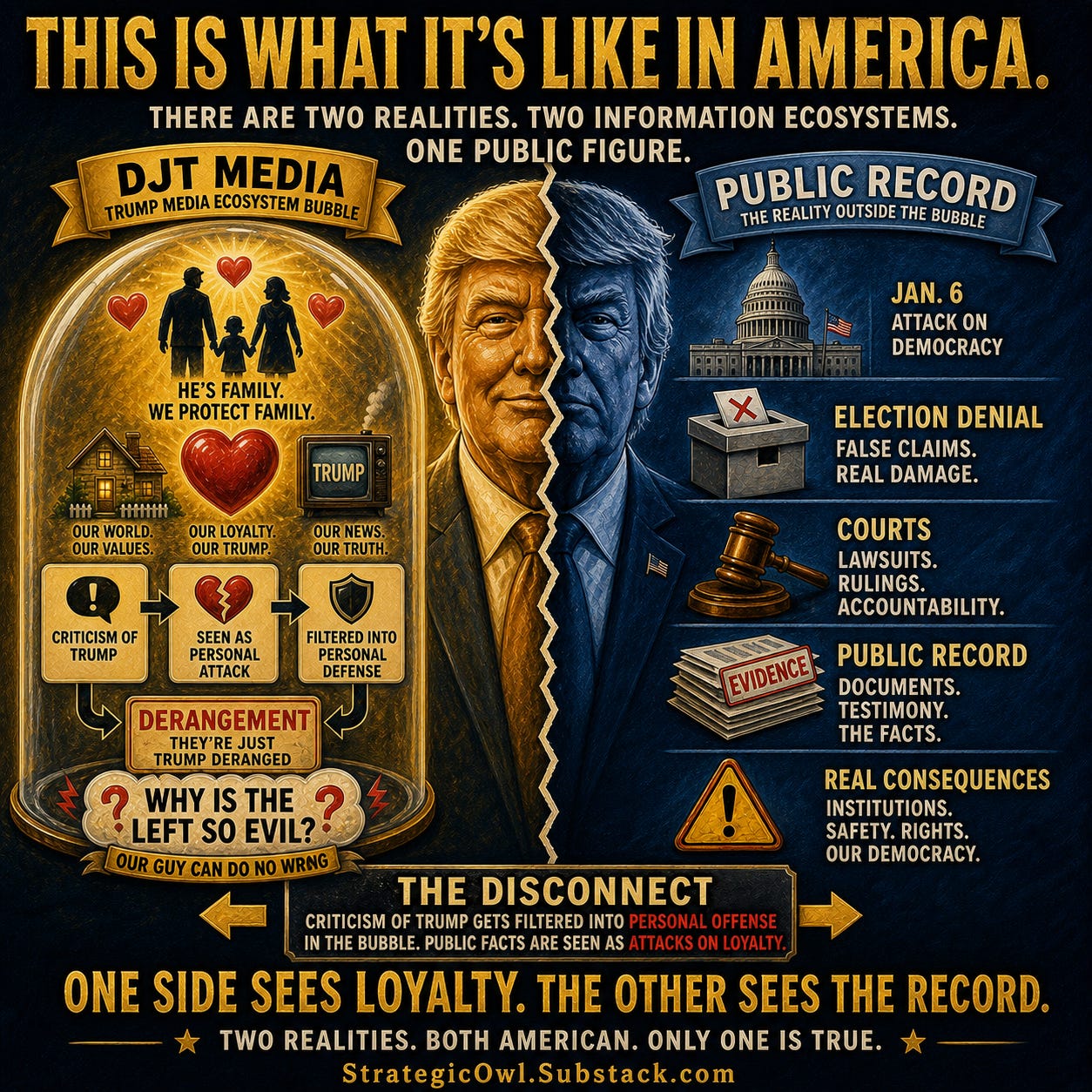
This is what brings me to the reality I am trying to explain.
I made the image above because this subject is hard to talk about in a normal way. The moment you mention Trump, many people stop hearing the argument and start sorting the speaker. Pro-Trump. Anti-Trump. Liberal. Conservative. Mainstream media. TDS. "Both sides.
That sorting process is part of the problem.
What I am trying to show is not simply that some Americans are “in a bubble” and others are not. It is more complicated than that. A lot of Americans are not sitting around watching hours of MAGA media every day. They are hearing pieces of it secondhand. A clip from a friend. A Facebook post from a relative. A podcast talking point. A meme. A politician repeating a story that started somewhere else. A casual conversation at work where someone says, “Well, I heard…”
That is how the Deflectogarchy travels: not only through formal media, but through hearsay.
The bubble does not need everyone to live fully inside it. It only needs enough people to absorb its assumptions. Trump is always being attacked. The media always lies. The courts are corrupt when they rule against him. Elections are suspicious when he loses. January 6th was exaggerated. The public record is not really the record. It is just another weapon being used by “them.”
That is the reality in America this image is trying to show.
It is not a clean divide between smart people and stupid people. It is a divide between two ways of processing information. One side keeps trying to point to records, testimony, documents, courts, certifications, and consequences. The other side often receives those same records through a loyalty filter before the facts can even be considered.
That is why January 6th is in the image.
January 6th is not the only reason Trump was unfit for power. It is one of the clearest examples because it brought the underlying pattern into the open. The attacks on institutions, the constant lying, the pressure on public servants, the demand for personal loyalty, the use of chaos as a political tool, and the habit of treating every limit on his power as illegitimate were not new that day. They were visible throughout his first presidency for people who were paying attention.
I was not paying enough attention then. I had to learn that pattern afterward by reading, comparing accounts, and trying to understand what I had missed.
That is part of the problem in America now. Many people are still living in the same posture I was in before January 6th: detached, busy, selectively informed, and assuming the guardrails will hold because they have held before. Others are trapped in epistemic closure, where every warning gets dismissed before it can be examined.
January 6th cuts through that fog because it is not just a matter of tone, personality, or partisan preference. It is a law-and-order event tied directly to the constitutional transfer of power. It showed what happens when a president’s habits collide with the peaceful transfer of authority.
That matters beyond Trump.
The danger is not only what Trump did. The danger is what future political operators learn from what Trump got away with. If a future candidate understands that millions of Americans do not know how certification works, do not understand the Electoral Count Act, do not understand the difference between legal challenges and fake authority, and can be convinced that every public record is fake if it hurts their side, then the next version of this crisis may be more disciplined.
That is why this cannot be reduced to ordinary partisan disagreement.
Trump is not just a Republican in the normal sense. He is a political figure who turned distrust into a loyalty system. He was shaped by people and tactics that many of his supporters have never seriously examined, from Roy Cohn’s attack-and-never-apologize style to Roger Stone’s dirty-tricks approach to politics. Those influences matter because they help explain the method: deny, attack, flood the zone, discredit the referee, and make accountability look like persecution.
This is why the image looks overwhelming.
The reality is overwhelming.
You cannot explain the Trump information ecosystem with one headline, one court case, or one clever comeback.
You have to show the machinery.
You have to show the loyalty frame, the hearsay network, the public records, the legal process, the emotional defense system, and the way criticism of one public figure gets translated into an attack on millions of people who identify with him.
That is the American reality I am trying to make visible.
Not because every Trump supporter is malicious.
Because enough Americans have been trained to defend Trump before they examine the record.
And that is why leading with labels rarely works.
Some of those labels exist for a reason. There are real extremists in and around the Trump movement. There are people who openly use fascist language, carry Nazi symbols, and defend authoritarian ideas. Pretending that does not exist would be dishonest.
But if your goal is to reach the average person who has absorbed pieces of the Trump media ecosystem through family, friends, podcasts, Facebook, or casual hearsay, leading with the harshest label usually does not create clarity. It creates defense.
They do not hear, “There are authoritarian patterns here that deserve serious attention.”
They hear, “You are evil. Your family is evil. Everyone you trust is evil.”
And once that happens, the Deflectogarchy starts doing its job.
It only pushes them deeper into the same defensive posture you are trying to break through. The better path is harder, slower, and more human: show them the reality clearly enough that they can recognize the pattern for themselves.
That is what worked for me.
I did not change because someone insulted me into clarity. I changed because I eventually slowed down, compared the story against the record, and realized the story did not survive contact with the evidence.
That is why I think positioning matters.
If you want to reach someone who has absorbed the Trump media ecosystem, you cannot only tell them they are wrong. You have to help them see what they were never shown. Most Trump supporters are not walking around thinking about Roy Cohn, Roger Stone, fake elector certificates, the Electoral Count Act, Rusty Bowers, Ruby Freeman, Shaye Moss, Judge J. Michael Luttig, or the mechanics of certification. Many have never had those names or concepts placed in front of them in a way that felt connected, clear, and worth examining.
That is where better sources matter, because the Deflectogarchy survives by making every source feel equally corrupt, equally biased, or equally fake.
I like MS NOW because I trust them to do the exhausting work of following Trump closely, checking the record, and staying with the story when most people do not have the time, patience, or emotional bandwidth to track every development themselves. That does not mean I outsource my thinking to them. It means I use good reporting as raw material, then compare, question, and think through the structure for myself.
For transparency, I also have a small position in Versant Media, which owns MS NOW. It is about $500, not some grand media empire from my office chair. But I do believe in putting my money where my mouth is. I invested because I value the journalism, and if they ever offer a monthly paid subscription, I would gladly consider supporting it that way too.
I also listen to people like Luke Beasley because he follows Trump closely enough that I do not have to live inside Trump’s feed all day. When I do check Trump’s Truth Social posts, I usually use a secondary site instead of going directly to the platform, because I do not want to help drive attention or advertising value back to him.
That is part of the larger point.
The goal is not to become obsessed with Trump. The goal is to understand the machinery well enough that Trump’s influence becomes easier to explain, easier to challenge, and harder to normalize.
That is also why I make infographics: the Trump public-record image above to help people understand Trump and the movement around him, and the civic-reform image below to show where repair can begin.
Feel free to save and share both images with family, friends, coworkers, or anyone you think may benefit from seeing the structure more clearly.
I made them because some conversations are hard to start with words alone. A visual can help people see the pattern before they feel the need to defend against it. That matters when you are trying to reach people who have learned to distrust institutional language, mainstream reporting, or anything that sounds immediately partisan.
Sometimes people may not listen when an argument sounds like it is coming from “the media,” “the left,” or “the system.” But they may be more willing to look when the idea is positioned clearly, visually, and humanly.
That is why I share my own experience too. I am not pretending I was always immune to the bubble. I know what it feels like to trust the story. And that is why I believe better positioning matters.

I will break down the civic-reform image in a separate article soon, because fixing America requires more than reacting to Trump. It requires understanding the movement, recognizing the incentives that keep it alive, and improving the systems that shape who governs us, how citizens understand government, and whether public service is actually valued.
I am trying to build tools for people who know something is wrong but have a hard time explaining it without sounding partisan, angry, or overwhelmed. Some of these subjects are complicated. The image is overwhelming because the reality is overwhelming. But if the structure becomes visible, the conversation becomes possible.
That is what The Strategic Owl is built around: truth, reliability, and understanding.
That means creating tools, essays, and visuals that help people slow down, check the record, understand the structure, and communicate more clearly without getting pulled back into the Deflectogarchy.
That includes how we use technology.
Some people call this moment the AI revolution. I call it the Neonascent Age, because the real opportunity is not replacing human thought. It is expanding it.
AI is not an oracle. It is not your friend. It is not a substitute for judgment, citizenship, or human connection. Used well, it is a tool that can help you understand complex subjects, trace claims, communicate more clearly, prepare better arguments, and navigate a world where information moves faster than most people can process.
That matters in everyday life too.
Companies are already figuring out that AI can make good employees better. Some companies will use it wisely, giving people more leverage to do higher-value work. Others will use it poorly, trying to replace people before they understand what human judgment actually does. Either way, workers who understand how to use AI as a thinking and communication tool will have an advantage over people who treat it like a gimmick or fear it without learning it.
That is why my paid subscriber section is starting with practical AI language-model tips.
Not hype. Not magic prompts. Not “let AI think for you.”
Tools.
Ways to understand reality better. Ways to verify sources. Ways to communicate what you learn. Ways to use AI to become more capable while still staying fully human.
If you’re a paid subscriber, your AI language-model tip begins below my signature.
The public arguments stay free because the core ideas matter too much to hide behind a paywall.
If you are not subscribed yet, the free subscription is the easiest way to follow the work and help these ideas reach more people.
If you are already a free subscriber and this work helps you think more clearly, communicate better, or explain what you are seeing in America, the paid subscription is there for the practical workflows behind the work. That is where I share how I use AI to clarify ideas, strengthen communication, check reasoning, and eventually build more complex tools, including code.
No pressure.
The article you just read is the point. The paid section is simply the workshop behind it.
And if a paid subscription is not the right fit, but you can afford to support the work and want to, there is also the Buy Me a Coffee option.
That one is personal. I work overnight, and this project gets built in my free time, usually in the hours most people never see. The coffee helps. The support helps. And honestly, every subscription, tip, share, and comment also helps prove that this time is not wasted.
Because not everyone around me understands this work.
Some people hear me criticize Trump and assume I became “some crazy liberal.” But that misses the point. My politics are more practical than that. I care about limited government, not only in size, but in power. I care about keeping the state out of private life while still expecting government to protect the public interest. I care about civic literacy, public accountability, women’s health care, personal freedom, and a government that works for citizens instead of demanding loyalty from them.
That is not outrage. That is citizenship.
The Strategic Owl is my way of giving shape to that work: explaining reality, building tools, improving communication, and helping regular people see through the noise without losing their humanity in the process.
So thank you for reading.
Thank you for thinking.
Thank you for being part of this work, whether you are a free reader, a paid subscriber, someone who shares the articles, or someone quietly using these ideas in conversations with family and friends.
Clarity creates connection.
And connection is how we start repairing the country.
Don’t let apathy win. Fight the good fight, America.
Taylor Irby 🦉 — May 6th, 2026
Independent Analyst: Data-Driven. Reality-Focused.
Explore more: TheStrategicOwl.com
Mobile App: The Strategic Owl App
Owl Merch: The Strategic Owl Merch
Below beings the paid section.