AI Skill: Practice the Conversation Before You Have It
A six-image Strategic Owl series on political evidence standards, media narratives, and using AI language models to prepare for grounded family conversations.

A quick note:
The main piece is free.
This is a new visual idea I am testing: taking a complicated argument and slowing it down one image at a time.
The paid section includes a practical AI language-model tip for preparing for difficult family conversations before they happen.
That is what I want these paid sections to be: useful tools for thinking clearly, communicating better, and staying grounded in the Neonascent Age.
- Irbs
I want to share a little of the thinking behind this visual series, because this format is new for us.
I know I can over-communicate. I do not say that to be self-deprecating. I say it because it is true. As a writer, I often want to give you the context, the evidence, the comparison, the public record, the framing, the caveats, and the takeaway all at once.
Apparently, that runs in the family.
A few evenings ago, I was walking my dogs during a warm Arizona spring afternoon, when the sun is just starting to drop, and I was on the phone with my grandfather. We were talking about communication, and my father came up.
He mentioned how my father has the same habit: if you ask him what time it is, he will tell you how to build a clock.
I laughed because I knew exactly what he meant.
My father sends me a lot of data. I do not think he realizes how overwhelming that can be for other people. He is not trying to bury anyone in information. He is trying to give people everything they might need to understand the point.
I think I inherited some of that. I do not just want to make a point. I want to show the structure underneath the point.
But I am also learning something important: giving people more information is not always the same as helping them understand.
Lately, I have noticed fewer people reading the longer articles here on Substack. I do not think that means the ideas are not useful. I think it means I may need to rethink how I communicate them.
That is where this new idea came from.
I wanted to break down why so many people believe Joe Biden is corrupt, especially when a lot of that belief traces back to the Hunter Biden laptop story. At first, I tried to show the full comparison in one image: the laptop story, how it spread, how it became political action, and how that evidence standard compares to the Trump-Epstein public record.
The phrase “a picture is worth a thousand words” sounds simple enough, but this idea reminded me that even images can get too crowded. Some of you saw that in The Strategic Owl chat when I shared the first version. It tried to carry the whole argument in one frame, and that became the tipping point. The idea was there, but the format was working against it.
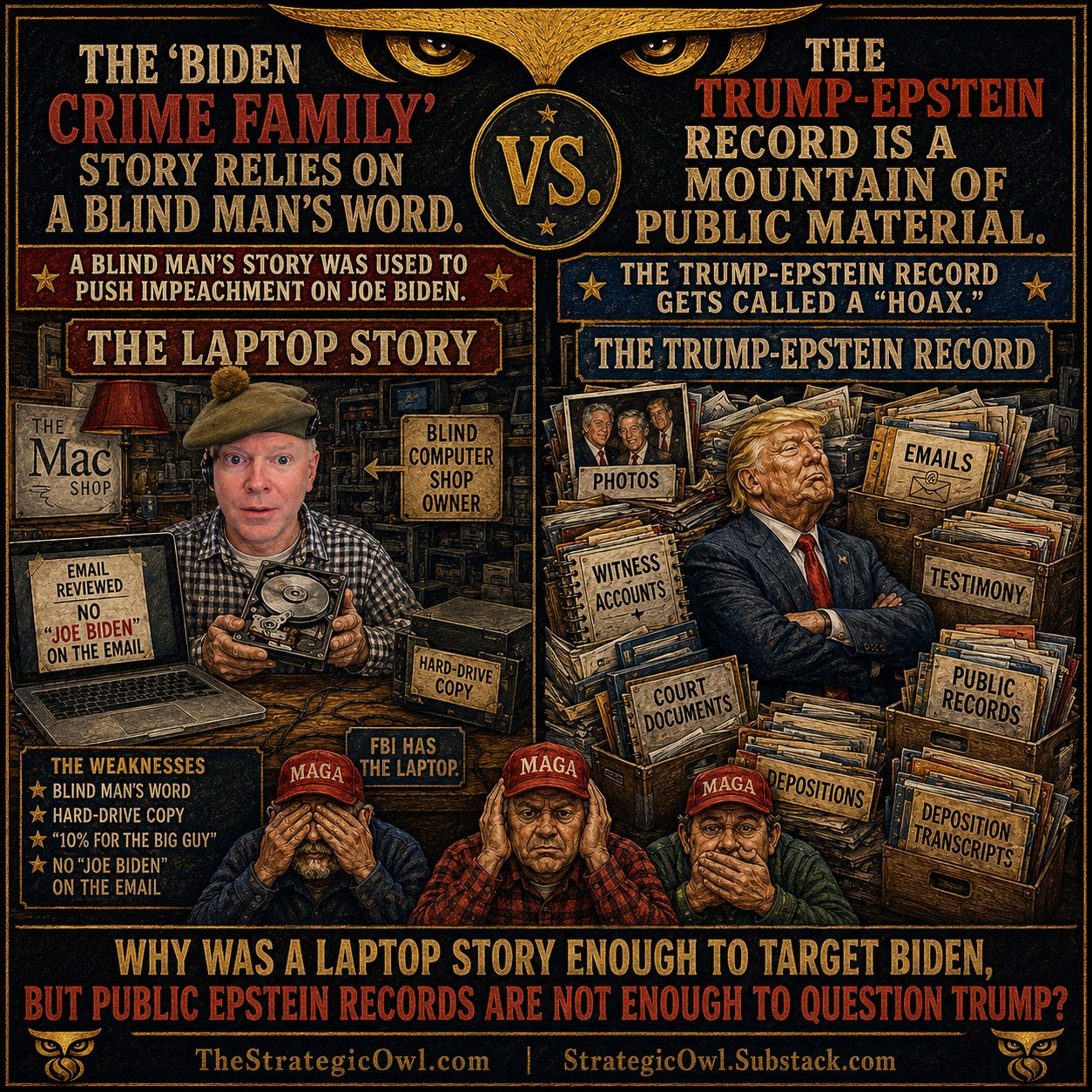
You can probably see the problem right away.
Some of your feedback helped me see the issue more clearly. The ideas were there, but the image was asking too much from you. If you have to zoom in, track every label, and study the image like homework, then I have not made the argument easier to understand. I have just moved the long-form article into a crowded visual.
That is when I started thinking about this more like a comic-book sequence.
Instead of making one image carry the whole argument, each frame can carry one part of the thought. One image introduces the question. Another adds context. Another shows the next step. That makes the argument easier to follow, easier to share, and easier to turn into other formats later, including short videos or reels where you can move through the idea one frame at a time.
I am trying to learn from that instead of ignoring it. If fewer people are making it through long-form pieces, then I need to think harder about how the idea reaches you in the first place. This series is my attempt to communicate better: one image, one idea, one step in the pattern. On Instagram, that can work as a swipeable series. Here on Substack, I can slow it down and add the context around each frame.
I am trying to learn from that instead of ignoring it. If fewer people are making it through long-form pieces, then I need to think harder about how the idea reaches you in the first place. This series is my attempt to take one overloaded argument and break it into a visual sequence, so each frame carries one part of the thought. On Instagram, that can work as a swipe-able series. Here on Substack, I can slow it down and add the context around each frame.
That is the experiment I want your feedback on.
If this format works, I can use it for other complicated subjects too. The next idea I am already thinking about is a visual series explaining how Trump tried to stay in power after the 2020 election.
If you are reading this for free, thank you. The core arguments will continue to be available because the point of The Strategic Owl is civic clarity, not hiding useful ideas behind a paywall. As a free subscriber, you help this work travel by reading, sharing, commenting, and bringing these visuals into real conversations.
Paid subscribers, thank you too. You help make this work more sustainable, and you also get the AI language model technical tips I include in paid posts. That is where I share practical ways to use AI to check sources, understand public records, test logic, and communicate more clearly. That tier is not about selling outrage. It is about building tools.
For anyone new here, The Strategic Owl is independent and self-funded, with support from a small group of you who help keep this work independent and moving. The purpose is simple: helping people slow down, look closely, and reconnect with reality-based civic reasoning.
I also want to be clear about something: I know times are hard. Support is never expected, always appreciated. I work on The Strategic Owl outside my overnight job, mostly in the quiet hours around my career and family life. All support helps cover the unglamorous parts of keeping this going: website costs, DNS, IP addresses, Apple developer fees, tools, and the time it takes to build all of this in the margins.
And yes, the coffee helps too. When you work overnight, even your days off tend to happen at night. Sometimes a cup of coffee is what keeps me awake while I am writing, coding, editing, or trying to explain one more complicated civic topic without sounding completely unhinged.
It also helps me make the case at home that I am not completely insane for spending my free time building civic tools, writing long breakdowns, and turning complicated arguments into owl-branded visual explainers.
So if this visual series helps you see the pattern more clearly, share it with someone who might benefit from the same clarity. And if you want to support the long game, subscribing, upgrading, or buying me a coffee helps keep the work moving.
The six images below are the first version of this new visual idea. Read them like a short sequence, not one poster trying to do everything at once. Each frame carries one part of the argument, so you can follow the pattern without decoding everything in one crowded image.
Start with the first frame and follow the sequence.
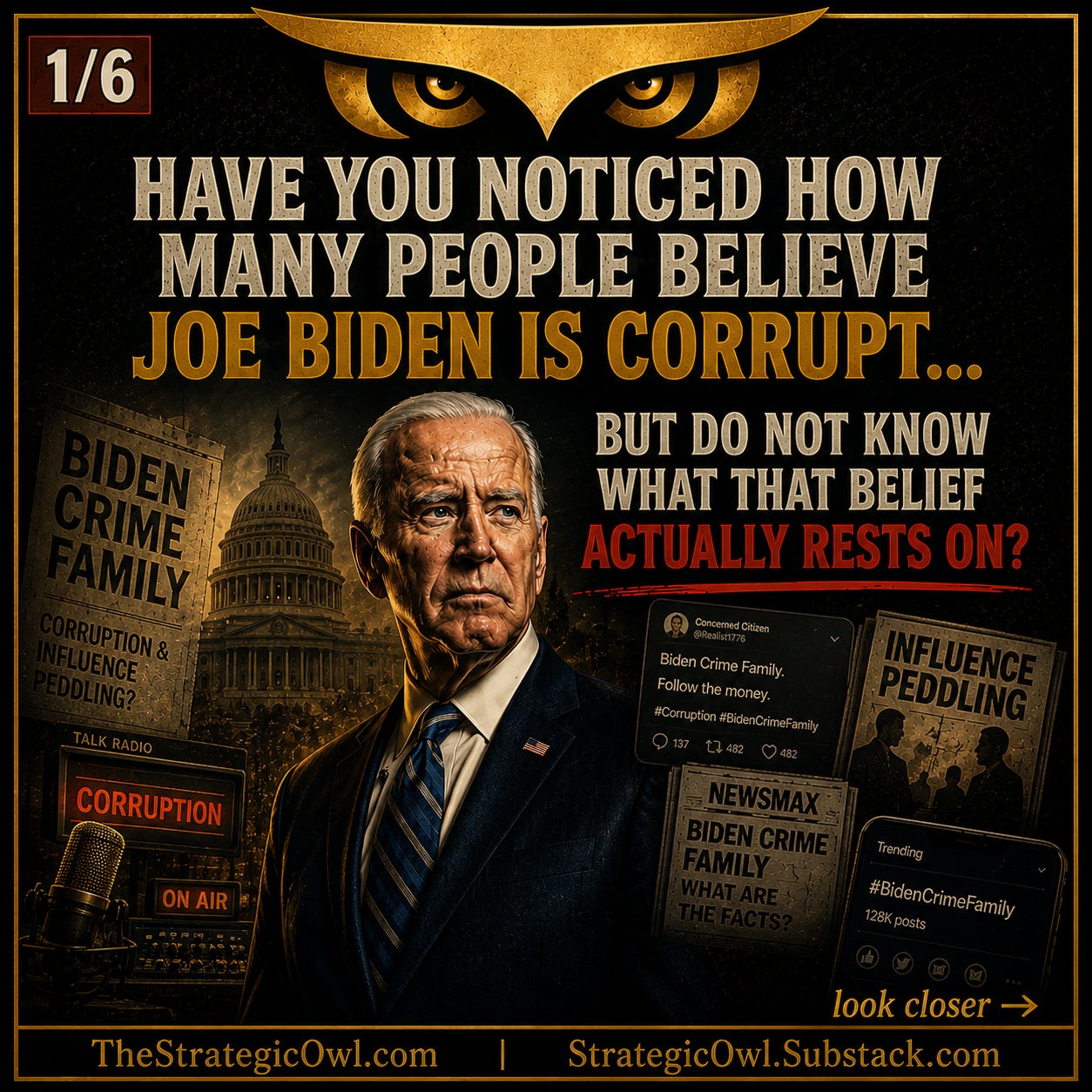
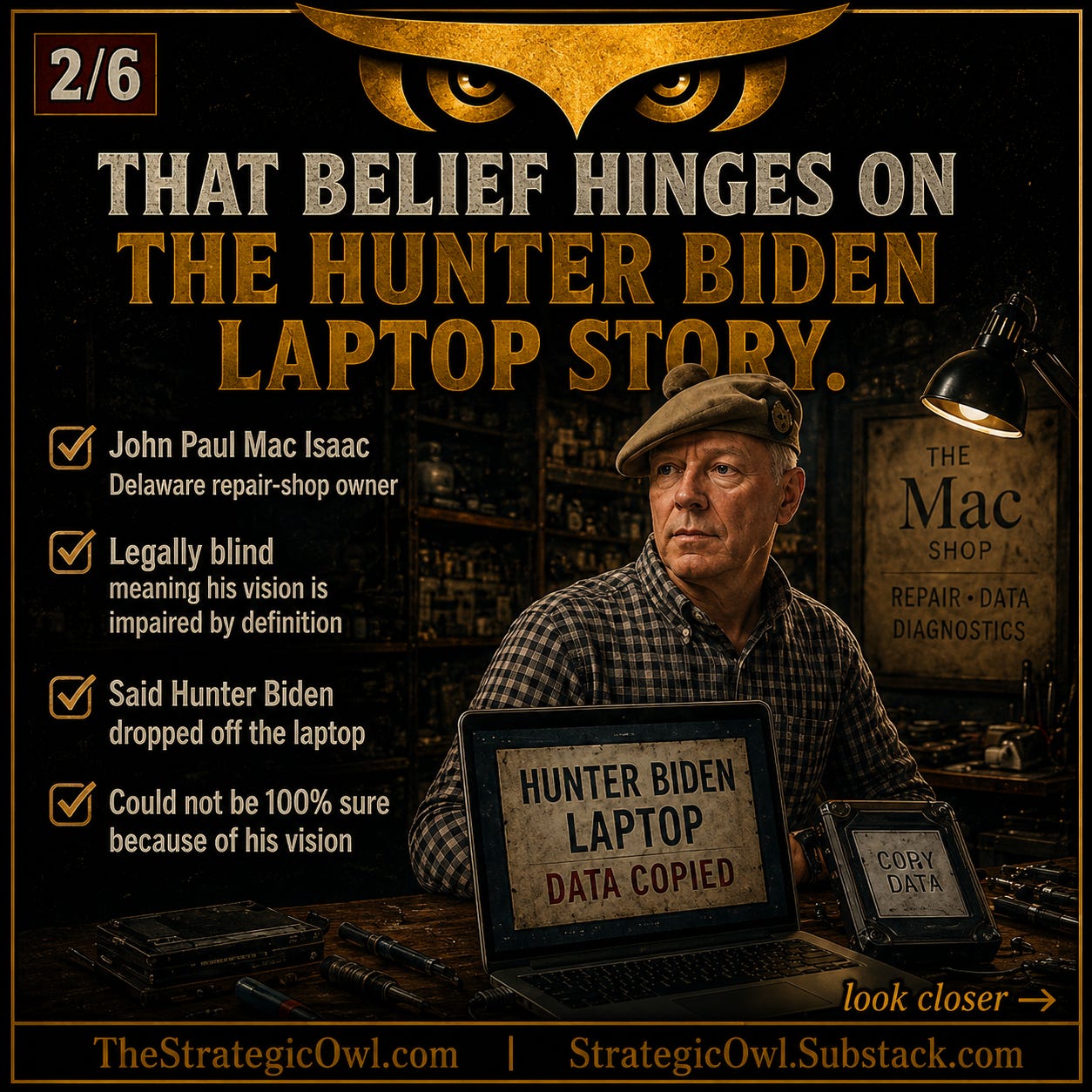
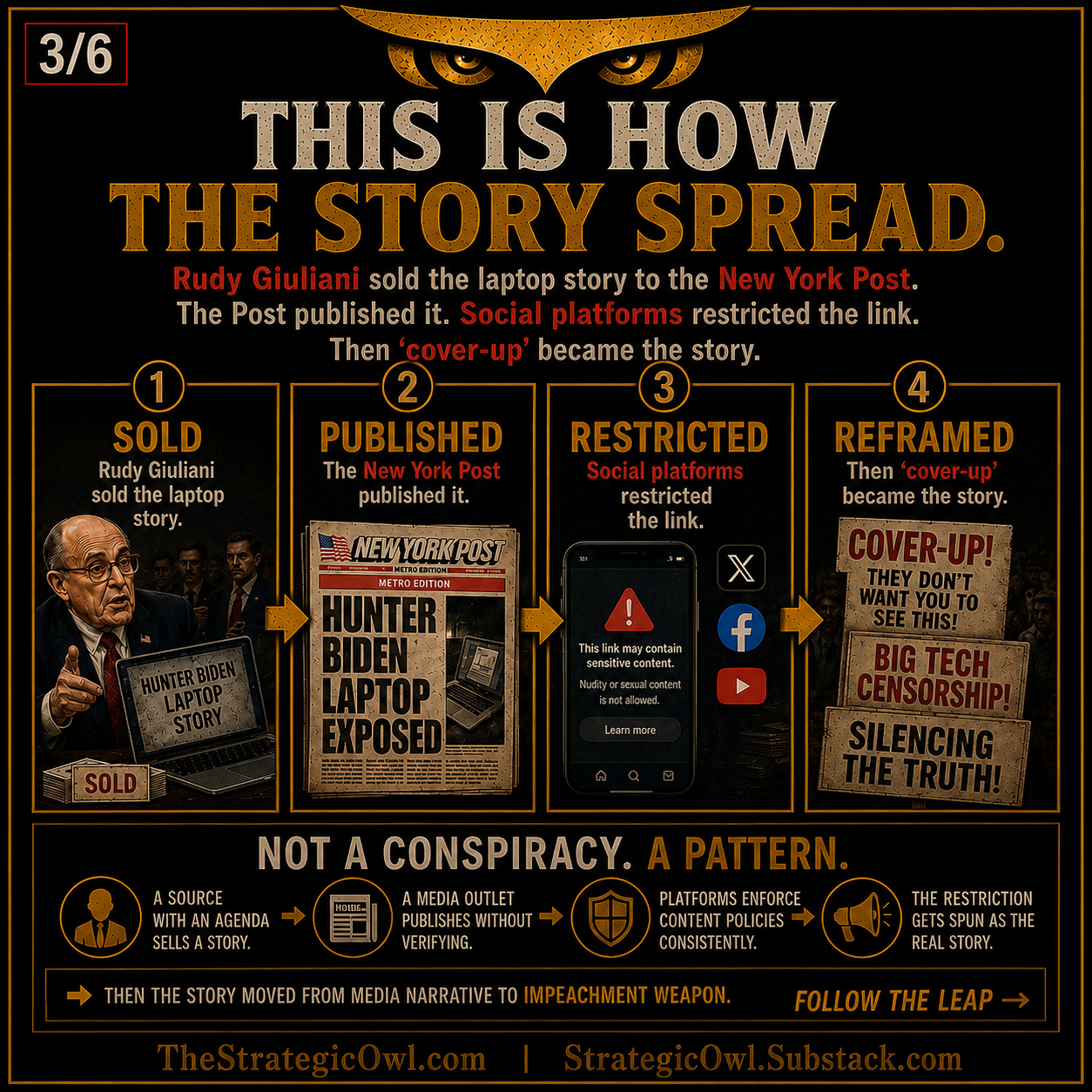
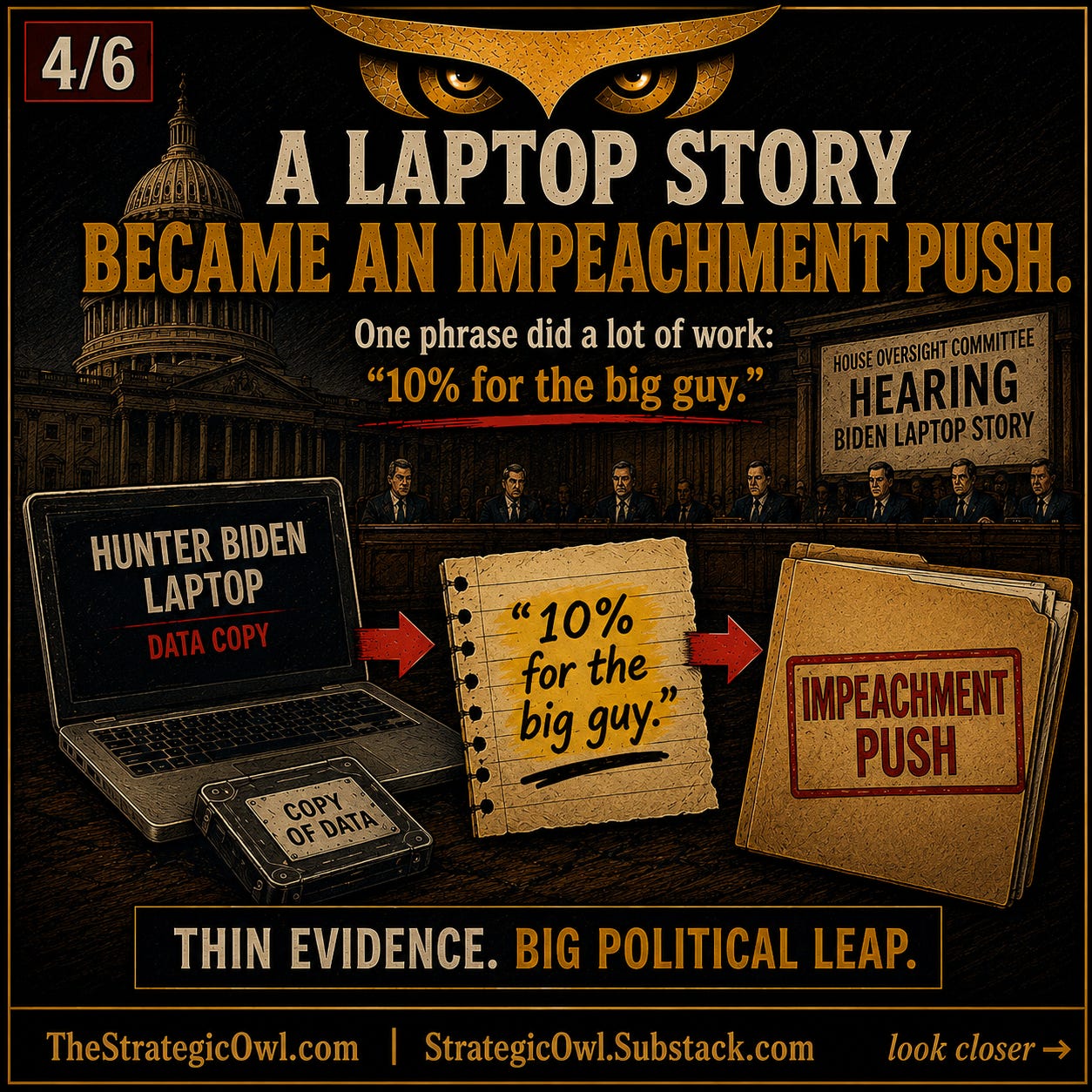
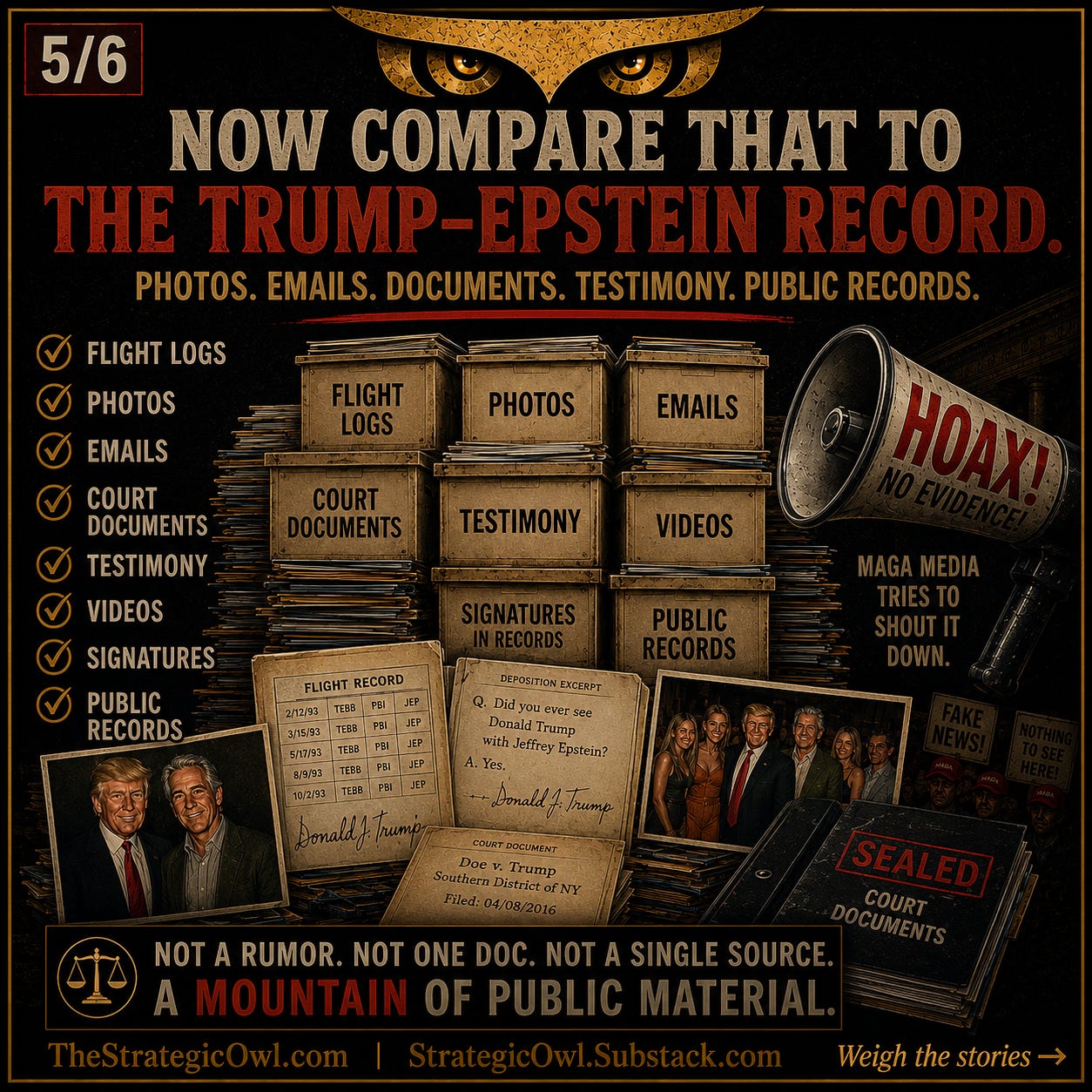

The point of this series is not that you have to memorize every detail of the Hunter Biden laptop story or every piece of the Trump-Epstein record. The point is that people were sold a story.
So, the next time someone says Joe Biden is corrupt, I want to encourage you to slow the conversation down and ask what that belief is actually built on.
Because this is likely where that belief came from, even if they do not realize it:
A legally blind repair-shop owner’s word. A laptop story. A vague phrase: “10% for the big guy.” No Joe Biden named in that phrase.
Now compare that to the Trump-Epstein record: Trump’s name, photos, documents, testimony, signatures, public records, and years of documented overlap.
That is the pattern.
A thin story gets treated like proof.
A named public record gets waved away as a hoax.
If these images help you explain that more clearly, save them. Share them. Or send someone to The Strategic Owl when the conversation gets stuck in slogans.
I write and create this work for you, but I also create it for the people you are trying to reach. That became clearer to me through your feedback, because I know a lot of this can feel like preaching to the choir here.
I can post the same ideas on Facebook or other platforms, but if someone is deep inside the MAGA media bubble, this kind of work often gets dismissed before it is even considered as “TDS” or biased content.
That is why I believe our loved ones are usually the best chance we have. You are more likely to be heard by your family than I am as a stranger on the internet.
That does not make the conversation easy. It can be frustrating, exhausting, and personal. But that is exactly why I make this work for both sides of the conversation: for you, and for the people you are still trying to reach.
Sometimes the most useful thing you can do is not argue harder. It is to give someone a clearer way to see what they are actually being asked to believe.
Thanks for reading.
Paid readers, your AI language model technical tip for living in the Neonascent Age is below.
Don’t let apathy win. Fight the good fight, America.
Taylor Irby 🦉 — May 10th, 2026
Independent Analyst: Data-Driven. Reality-Focused.
Explore more: TheStrategicOwl.com
Mobile App: The Strategic Owl App
Owl Merch: The Strategic Owl Merch
If this helped: Buy Me a Coffee!