God Bless America
Narratives. Symbols. Contrast. Participation. Messaging. Choice. America.

Before we begin, a brief note:
The main piece is free. There’s an optional paid section at the end for readers who support the work. It includes AI language-model and technical tips to help you live in the Neonascent Age. - Irbs
“God Bless America”
“God bless America — from Chile, Argentina, Uruguay, Paraguay, Bolivia, Perú, Ecuador, Brasil, Colombia, Venezuela, Guyana, Panamá, Costa Rica, Nicaragua, Honduras, El Salvador, Guatemala, México, Cuba, República Dominicana, Jamaica, Antigua, the United States, Canadá… and my homeland, Puerto Rico. Seguimos aquí. ¡Ahora sí!”
- Benito Antonio Martínez Ocasio (also known as Bad Bunny)
@ The Super Bowl Halftime Show, Santa Clara, California
Those were the only words he spoke in English.
He could have said it in Spanish — “Dios bendiga a América.”
He didn’t.
That choice is worth pausing on.
Because in the following days, the MAGA movement would have you believe the performance was entirely in Spanish — the worst halftime show in U.S. history, divisive rather than unifying, and worthy of outrage.
I assembled a ten-minute video that captures how this narrative is being projected — pairing cultural reaction with the words actually spoken on that stage. Using clips from Jimmy Kimmel and Jon Stewart’s The Daily Show, it offers a clear look at the gap between the performance itself and the story some audiences are being encouraged to see. If it resonates with you, I invite you to share it. Thoughtful sharing helps extend the reach of this work and the civic tools I continue building through The Strategic Owl.
While one stage offered a vision of cultural breadth, another offered something more culturally defensive — a performance shaped less by artistic exploration and more by the language of grievance that has increasingly entered our national conversation.
Turning Point USA’s decision to produce an alternative halftime show was not merely counterprogramming; it was messaging. Stages are never neutral. They reflect the values of those who build them.
Consider the tone embedded in the lyrics themselves.
Kid Rock, long associated with rebellion as brand, built his persona around provocation. One of his most recognizable refrains leans into absurdist swagger — “Bawitdaba, da-bang, da-bang, diggy-diggy-diggy,” a lyric I remember enjoying as a child, likely drawn in by its sheer sonic absurdity rather than any deeper meaning.
Elsewhere, the provocation sharpens. Another song includes the line, “Young ladies… I like ’em underage,” followed by, “Some say that’s statutory… but I say it’s mandatory.” Whether intended as shock humor, boundary-testing theater, or cultural defiance, the effect is unmistakable: controversy is not incidental to the performance — it is woven into it.
Alongside that posture was a more subdued, but equally revealing, lyrical theme from artist Lee Brice. — a vision of life intentionally narrowed:
“I just want to catch my fish… drink my beer.”
“Cut my grass… feed my dogs.”
There is nothing inherently wrong with celebrating ordinary life. Simplicity can be grounding. But when simplicity is framed as a retreat from cultural change — even suggesting that speaking openly about transgender people invites punishment — the message shifts. It becomes less about peace and more about avoidance.
Art has always reflected the anxieties of its era. Yet the most enduring art tends to expand our imagination rather than contract it. What emerged from this alternative stage was not rebellion in the classic artistic sense, but cultural guardedness — music less interested in exploring the future than in insulating itself from it.
That posture mirrors a broader narrative often promoted within the Turning Point USA ecosystem: that higher education is not a gateway to intellectual growth but a mechanism of ideological indoctrination. Students, they argue, risk absorption into a “woke hive mind.”
It is a compelling story, particularly for young people searching for certainty in an unsettled world.
But democratic societies have historically depended on institutions that challenge assumptions rather than protect them. Colleges and universities — imperfect as they are — remain among the few environments where individuals are asked to wrestle with unfamiliar ideas, refine their reasoning, and develop intellectual resilience.
Encouraging distance from those spaces risks producing not independence, but isolation.
Taken together, the themes projected from this alternative stage — cultural alarm, retreat into personal comfort, suspicion of institutions — gesture toward a quieter but more consequential proposition: that citizenship is best practiced at arm’s length.
And distance, in a democratic republic, is rarely a strength.
That posture — the quiet suggestion that life is best lived at a distance from cultural and political friction — reminded me of a conversation I recently had with a coworker who trains in mixed martial arts. Many of the athletes he practices with are Russian, and he once shared something that lingered with me: they find it unusual that Americans talk about politics at all.
In parts of the world shaped by stronger central authority, political discussion is often treated less as civic participation and more as unnecessary risk. Privacy becomes protection. Silence becomes habit.
But the American experiment has long depended on the opposite instinct.
Self-government is not sustained by detachment; it requires engagement — sometimes messy, often uncomfortable, but essential. A healthy republic asks its citizens not merely to live within it, but to participate in the ongoing argument about what it should become.
Which is why messaging that encourages people to tune out the wider world deserves a closer look. When disengagement is normalized, civic muscle weakens. And over time, what begins as cultural withdrawal can quietly erode the participatory spirit on which democratic societies rely.
After all the criticism, the outrage, and the cultural noise surrounding the halftime show, this is what the MAGA movement didn’t want you to hear:
“Mi nombre es Benito Antonio Martínez Ocasio.
Y si hoy estoy aquí es porque nunca, nunca dejé de creer en mí.Tú también deberías creer en ti —
para lograr lo que piensas.Créeme.”
Translation:
“My name is Benito Antonio Martínez Ocasio.
And if I’m standing here today, it’s because I never — never — stopped believing in myself.You should believe in yourself too…
so you can achieve what you imagine.Trust me.”
I want to be honest about my reaction to that moment — it almost made me tear up.
I’ve watched a lot of halftime shows over the years, and I can’t remember another one that stirred that kind of emotion in me. Maybe it was the timing. Maybe it was the message. Maybe it was hearing someone introduce himself plainly and speak about belief on one of the largest stages in American culture.
But it landed.
Especially when you remember how the performance ended — with “God bless America.”
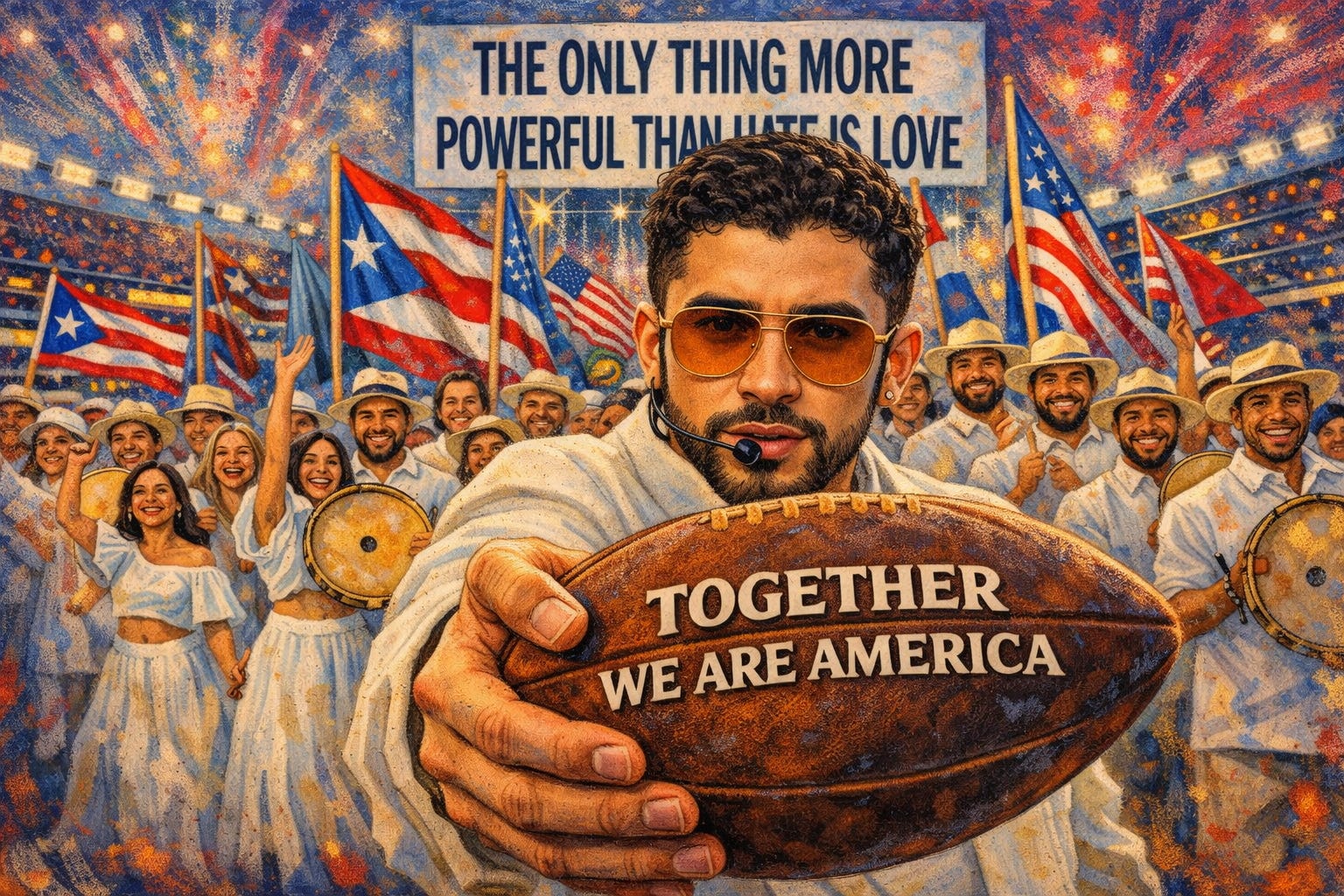
Behind him, stretched across the stadium’s jumbotron, was a message that remained visible throughout the moment:
“The only thing more powerful than hate is love.”
Then, in a brief but unmistakable gesture, he lifted a football bearing a quiet declaration:
“Together, We Are America.”
Set that beside the themes projected from the alternative stage — lyrics leaning on sexual provocation involving underage girls, alongside messages that romanticize disengagement from the broader world — and a more consequential question begins to surface:
What kind of America do we want to elevate?
One defined by suspicion and cultural retreat, or one that still finds power in belief, possibility, and shared identity?
One that narrows who belongs, or one that reminds us we are, in fact, together?
The contrast does not require exaggeration.
It simply asks us to decide what we are willing to normalize — and what we are willing to stand behind.
Years ago, after my father ran for city council — and won — I attended one of my local council meetings. What struck me wasn’t the debate. It was the emptiness of the room. Very few citizens were there.
I mentioned it to him in a conversation afterward. That’s when he said something that has stayed with me:
“Governments represent those who participate and participation goes beyond voting.”
At the time, I understood that to mean more than casting a ballot in a presidential year. It meant attending meetings. Staying informed. Speaking during public comment. Engaging not only with elected officials, but with fellow citizens. Participation, he was telling me, is not episodic — it is ongoing.
Some of you who have been reading me for a while already know this, but for those who are new here: I did not always think this way. For more than a decade, I consumed a steady diet of conspiracy media — from Alex Jones to long stretches of Joe Rogan. That ecosystem thrives on suspicion of institutions and distrust of public processes. It can feel like awareness. In hindsight, much of it cultivated something else: detachment.
Apathy does not always look like laziness. Sometimes it looks like endless commentary with no civic engagement attached to it.
And apathy has historically been dangerous terrain for free societies. Political theorists have long observed that republics weaken not only from corruption, but from disengagement — when citizens retreat from participation and leave institutional power uncontested.
This is why messaging matters.
Organizations like Turning Point USA are not merely hosting events; they are shaping political identity among young people. That is not inherently sinister — youth political movements have existed across the ideological spectrum and throughout history. But history also shows that when movements frame universities, journalists, courts, and other civic institutions as enemies rather than arenas for engagement, they shift participation from inquiry toward allegiance.
In the twentieth century, authoritarian regimes did not simply seize power; they cultivated loyalty — particularly among youth — through tightly organized political identity structures. The lesson is not that modern movements are identical to those regimes. It is that institutions shape civic behavior, and sustained political messaging can narrow or widen how citizens understand their role in a republic.
If colleges are described primarily as sites of indoctrination, and alternative political ecosystems present themselves as the “true” source of knowledge, we should at least pause long enough to ask a question:
Are we encouraging independent thinking — or replacing one institution with another?
Governments represent those who participate.
If participation is reduced to allegiance within a single ideological lane, the republic becomes smaller, not stronger.
If there is one thing I hope you carry forward from this, it is not outrage — it is positioning.
Many people today operate inside tightly sealed information environments, where opposing viewpoints are dismissed before they are even considered. You have likely encountered this with friends, family members, or coworkers. When beliefs become insulated from challenge, conversations can quickly harden into performance rather than understanding.
So here is the opportunity:
Do not meet volume with volume.
Do not answer insult with insult.
And above all — do not take it personally.
When a discussion turns immature or deflective, name the behavior calmly and return the conversation to the substance. Composure is not weakness; it is leverage. The person who remains grounded often shapes the direction of the dialogue.
Just as important is how we listen. Listen to understand, not merely to respond. Acknowledge what the other person has said before offering your own perspective. That simple act lowers defenses and makes real conversation possible. There is science behind this — when people feel acknowledged, their brains reduce threat responses and become more receptive.
I learned this long before writing about civics. Over thirteen years on the phones — more than 20,000 hours speaking with people from every corner of the country — I saw the same pattern again and again: conversations improve when people feel heard. Later communication training only reinforced what experience had already taught me.
Most people are not following the news closely. Many are busy, distracted, or understandably fatigued by the noise of modern life. Apathy, more often than hostility, is what shapes public disengagement. That is precisely why difficult conversations matter. Democracies depend not on perfect agreement, but on the willingness of ordinary citizens to stay engaged with one another.
If you choose to enter these conversations, do so with steadiness. Ask questions. Stay curious. Resist the pull toward knee-jerk reactions — they are often expected, and refusing to provide them changes the dynamic immediately.
You do not need to win every exchange.
But you can elevate it.
And in a democratic republic, raising the level of our conversations is itself a form of participation.
If you’ve read this far, I hope this helped — even in a small way. Attention is scarce, and you chose to spend yours here.
I don’t advertise this work. I don’t have a marketing budget. This project grows the old-fashioned way: word of mouth. On Substack, that means something simple but powerful — tapping the heart, restacking the piece, and sharing it with someone who might benefit from the conversation. Those small actions drive the algorithm. They help thoughtful work travel without outrage or paid amplification.
If this resonated with you, that’s the most meaningful way to support it.
If you’re not subscribed, I invite you to join. Subscribing is free. A free subscription gives you access to the ongoing conversation — the chat, the Notes, and the visual posts that use satire and perspective to interrupt autopilot reactions and reopen dialogue. I don’t believe in charging people for ideas. The core message will always remain accessible.
For those who want to support the work more directly, there is also a paid tier. Think of it less as a paywall and more as a thank-you exchange. Paid subscribers receive practical AI language-model and technical tips — the real ways I use these tools to build messages like this one. There are millions of ways to use AI; I share the methods that actually save time and sharpen clarity.
Paid subscribers also receive access to a private VIP storefront link with discounted merchandise — about 18% lower than the regular shop. That pricing exists as a gesture of appreciation for helping sustain something built entirely in my free time.
Owl merchandise exists for the same reason this work exists: to carry conversations into the real world. Not as branding, but as signals and conversation starters. Some of it is direct, some of it is satirical, and some of it is intentionally uncomfortable — because discomfort is often what breaks reflexive thinking. Phrases like “Fuck Trump, not you,” “Make America Think Again,” “Make America Talk Again,” “Kamala was right,” “Fuck the Deflectogarchy,” or “Defy the Deflectogarchy” aren’t about winning arguments. They’re about interrupting autopilot reactions and creating space for actual dialogue in a culture trained to respond instead of listen.
If subscriptions aren’t your thing, that’s completely fair. There’s also a “Buy Me a Coffee” option for anyone who prefers one-time support or simply doesn’t want to share an email address. It’s never expected and always appreciated.
This project exists because I refuse to let apathy win. I believe Americans are being divided — strategically and repeatedly — and I believe thoughtful participation is still possible. Everything here is built in spare hours by a regular citizen trying to reunite conversations that have hardened into camps.
Thank you for reading.
And thank you for your attention to this matter. 😉
Defy The Deflectogarchy
Don’t let apathy win. Fight the good fight, America.
Taylor Irby 🦉 — February 11th, 2026
Independent Analyst: Data-Driven. Reality-Focused.